
Local Santa Cruz Service
Washer Repair
Santa Cruz, CA
Fast washer repair in Santa Cruz, with clear pricing and real answers.
If you need washer repair in Santa Cruz, call (831) 231 6160. Tell us the brand and model; we triage safety and water damage risks like active leaks or burning smells first.
Status
Locally Owned
Coverage
Full County
Safety
Insured
Pricing
Upfront Quotes
Workflow, Costs & Decision Logic
Step-by-Step Transparency
Contact
Brand, model, symptom, and error codes gathered upfront.
Arrival Window
Realistic windows (2-4 hours). Urgent calls prioritized.
Arrival & Care
Workspace controlled. Machine moved with floor protection.
Diagnostics
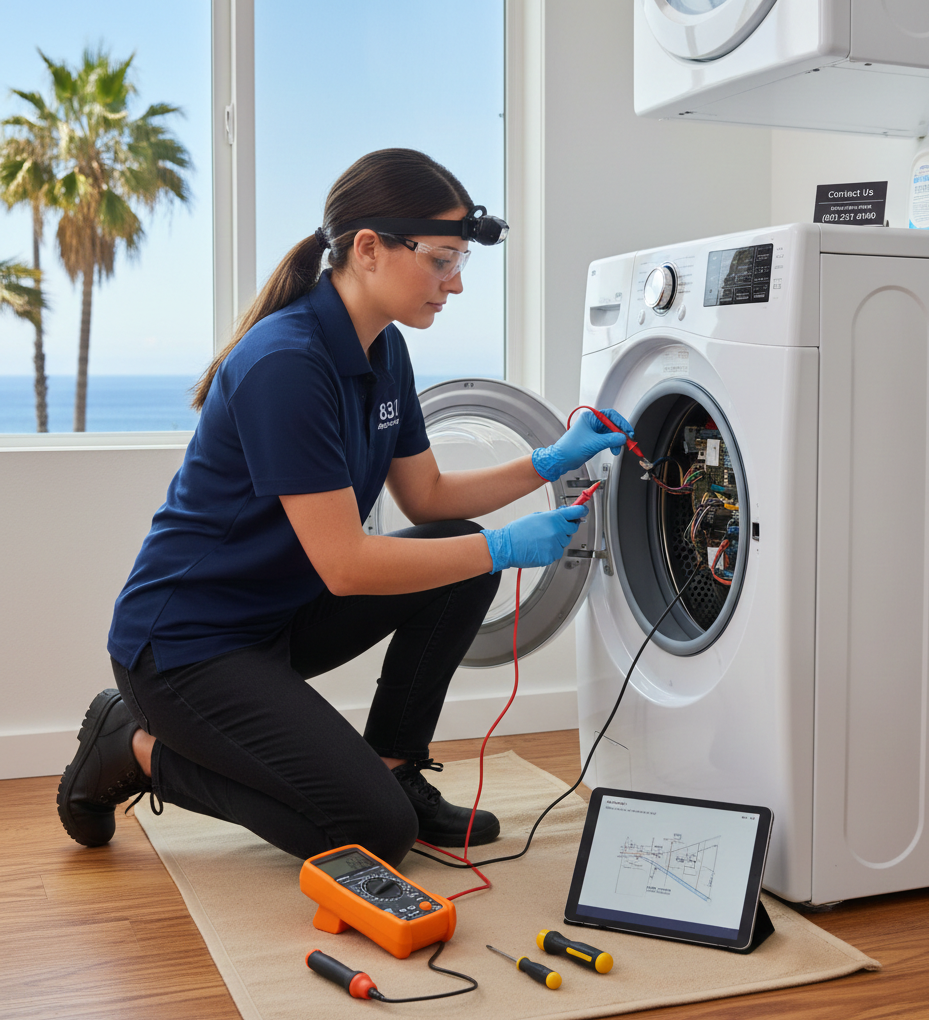
Testing pumps, locks, and sensors with multimeter precision.
Written Estimate
Clear options explained before work begins.
Repair & Verify
Function confirmed through fill, drain, and spin cycles.
Wrap Up
Failure explained. Workspace cleaned. Old parts shown.
Prevention Advice
Warranty terms provided in plain language.
Washer Repair Costs
Repair cost depends on failure type, part cost for your model, and access time (especially for stacked units).
Simple Repairs
Lid switch, door latch, hose issue
Low Hundreds
Moderate Repairs
Drain pump, suspension work, boot seal
Mid Hundreds
Complex Repairs
Bearing and tub work, major control faults
High Hundreds
Diagnostic Policy:
Visit fee is typically $80 to $100 and is credited toward the repair when you approve the work.
Common Washer Problems We Fix Every Week
Washer will not drain
The washer fills, tumbles, then sits there full of water. Clogged drain pump filters on front loaders or jammed impellers from coins and pins are the top causes. Oversudsing from too much detergent also confuses sensors and stops draining logic. Check our complete Appliance Repair In Santa Cruz
Washer will not spin or spins weakly
A washer refuses to spin when it senses risk. Common causes include door lock or lid switch faults, worn suspension rods/shock absorbers, or motor control faults. If it shakes violently, stop the cycle immediately; a violent spin can damage the tub support.
Shakes, bangs, or “walks”
If your washer sounds like it is trying to escape, it is likely worn suspension components or floor movement in older homes. Catching it early usually saves you an expensive mechanical repair later.
Smells bad or musty odor
Common with front load units due to moisture trapped in gasket folds and detergent residue. Santa Cruz humidity makes it worse. A clean washer should not smell sour; if it does, something is feeding growth.
Stops mid cycle / Will not start
Can be as simple as a tripped breaker or as complex as a control board fault. Door lock failures often look like a dead washer entirely. Write down error codes before you reset power.
How We Diagnose Your Washer Properly
We do not show up and start replacing parts based on symptoms alone. Here is what real diagnosis looks like.
Initial Assessment
We analyze the washer type, age, and installation. We note whether it sits in a closet, garage, or second-floor laundry. Front-load and top-load patterns differ significantly.
Operational Testing
We run the washer through key steps: Fill, Tumble/Agitate, Drain, and Spin. We listen for grinding, clicking, or banging to pinpoint mechanical vs. electrical failures.
Electrical & Mechanical Testing
Using digital multimeters, we test door latches, pumps, motors, and inlet valves for voltage, continuity, and resistance. We check belts, couplers, and suspension rods for wear.
System Analysis
We look at how systems interact. A washer that will not spin might have a drain issue, not a motor issue. A leak might be a hose, not the tub. We confirm the actual root cause.
“Here is the thing. A washer does not break when you are bored.”
It breaks when laundry is stacked. It breaks when beach towels show up sandy. It breaks when you need uniforms clean by morning. And the worst part is not the noise—it is the uncertainty.
Is it safe to run another cycle? Will it flood the laundry room? Is it a simple drain clog or something bigger? Will you get a real estimate or a guessing game? This page is built to remove that uncertainty. It explains what we fix, how we diagnose, what to do right now, and what to expect from a professional washer repair visit in Santa Cruz.
The Small Truth: “Kind of” Problems
Most washer problems start as “kind of” problems. The washer drains slowly, but it finishes. It spins, but clothes come out wetter. It shakes, but only on towels. It smells musty, but you ignore it. Then one day it stops mid-cycle, or dumps water on the floor, or bangs so hard you think it will walk out of the closet.
Santa Cruz can make that journey faster. Coastal humidity can feed mildew on seals. Salt air can speed corrosion on connectors. Beach sand can clog pump filters faster than you expect. Mountain rentals can stress machines with heavy weekly loads. None of this is dramatic. It is just real life here.
Our Strict “No” List:
- • We will not start work without approval.
- • We will not “swap parts until it works.”
- • We will not pretend every issue is an emergency.
- • We will not talk down to you.
What to do right now:
- Turn the washer off immediately.
- Do not keep restarting cycles.
- Check the drain hose for a kink.
- Place towels if leaking.
Washer Types & Santa Cruz Patterns
Front Load Washer Repair
Front load washers save water and energy. They also have very predictable trouble spots. Coastal humidity does not help—they can smell fine for weeks, then smell awful suddenly.
- • Door boot seal leaks
- • Drain pump clogs (lint/debris)
- • Door lock failures
- • Musty odor from the gasket
- • Bearing or tub issues
Top Load Washer Repair
From agitators to impellers, top loaders vary by design. They can be easier to access, but mechanical failures often lead to violent “walking” during spin.
- • Lid switch failures
- • Drive belt and coupler wear
- • Suspension rod wear
- • Direct drive control faults
- • Drain pump blockages
The Detergent Problem
High efficiency washers require small amounts of HE detergent. Many people use too much. Those suds build up in pump areas and passages, creating hardened “detergent sludge” that mimics a broken pump.
“Less detergent usually cleans better in HE washers. More is not better.”
Maintenance & Seasonal Trends
Preventative Care
Do not overload. Check pockets for coins. Leave the door ajar on front loaders. Wipe gasket folds regularly. Clean the pump filter monthly if accessible. Inspect hoses for bulges or cracking annually.
Seasonal Spikes
Summer brings heavy towel loads and rental turnover, wearing machines faster. Winter moisture increases musty odors. Weekend demand spikes on Saturday mornings—call early for best availability.
Why Choose Us in Santa Cruz
We start with diagnosis, not guessing. We test components like the drain pump and door lock before quoting. We tell you when a repair is not worth it—that honesty matters long term.
Local Knowledge
We see the patterns. Tight laundry closets common in older bungalows require specific access techniques. Beach life reality—sand and grit—is a core part of our local diagnosis process.
Washer Repair FAQ
In many cases we can schedule quickly, sometimes the same day. It depends on your location and the schedule. Call early, have your model number ready, and describe the symptom in one sentence. safety risks like leaks or sparks get triaged first.
Sometimes, yes. Same day depends on the schedule and where you are in the county. Morning calls usually have more options. If your washer is leaking or flooding, tell us first—that changes urgency immediately.
We do not give firm repair prices without diagnosis. Diagnosis prevents wrong part replacements and protects you from paying for a guess. If you choose not to move forward after diagnosis, you typically pay only the diagnostic visit fee.
Common repairs land in the lower to mid hundreds. Larger mechanical repairs or complex access (stacked units) can cost more. You should always get a written estimate after diagnosis and before work begins.
Repair often makes sense for isolated failures on reliable machines. Replacement is smarter for repeated failures or when cost approaches replacement value. We give you the facts after diagnosis, and you decide.
We service most major brands and many premium brands. If your brand isn’t listed, call us—the model number usually answers the question fast.
Turn the washer off and avoid running more cycles. Check for kinked hoses. If it’s full of water, keep it away from outlets. If it’s leaking, shut off the water valves immediately and schedule service.
It may refuse to spin if it cannot drain, or if a door lock/lid switch fails. Unbalanced loads also stop spins on many models. Diagnosis confirms the exact cause so you don’t waste money swapping the wrong part.
Yes. Even small leaks can damage subflooring over time. Turn off valves, use towels, and avoid power cords. It is easier to stop water now than repair flooring later.
Clear access to the washer. Have the model number ready. Write down error codes. Tell us if it’s stacked or in a tight closet. Small prep steps make the visit faster.
Moisture and salt speed up corrosion. We check these points carefully in Seabright and coastal areas. High humidity also feeds gasket mildew.
Some neighborhoods have mineral deposits that clog inlet screens. Low flow triggers fill errors. Local experience means we check this first.
Sand and grit collect in filters. Heavy towel loads wear suspension faster. Mention if you wash lots of beach gear regularly.
Mildew in gaskets or detergent sludge build up. Leave the door open between loads and run tub-clean cycles regularly.
Check your panel first. A door lock failure can mimic a dead machine. We test the flow of power to be certain before recommending parts.
90-day labor warranty. We are locally owned—our reputation in Santa Cruz matters more than a single job. We focus on durable fixes.
Book Washer Repair in Santa Cruz
Do not panic, but do not ignore it either. The difference between a manageable repair and a disaster is usually how quickly you address it.
Santa Cruz County Locally Owned • Licensed & Bonded